

The Key to Reproducible Thin-Layer Chromatography: Controlling Development Conditions
Drifting or inconsistent Rf values are a common struggle in Thin Layer Chromatography analysis. By understanding and controlling a few hidden variables in the development step in particular, Thin Layer Chromatography (TLC) can be transformed into a reliable, reproducible technique which can be used for so much more than an identification analysis technique.
When planning a TLC analysis, the variables which are considered for development are mobile phase composition and development distance. However, in order to assess the performance of the mobile phase and achieve a robust method, all other environmental chamber and plate conditions must also be kept consistent for every analysis.
Temperature
Humidity
Chamber saturation
Timing (of Plate Introduction and Removal)
Development distance
All have an impact on Rf value, and while some can be addressed by taking by taking greater care with plate handling and storage, others can be difficult to control. Especially when using a manual chamber for development.
For example, keeping the chamber in a saturated state, where the gaseous phase and liquid phase of the developing solvent mixture are in equilibrium. When manually introducing the plate into the chamber, even with much practice, it is inevitable that some of the gaseous phase will escape while the chamber lid is briefly removed.
Another example is controlling the atmospheric humidity around the plate. The effect of humidity on TLC and HPTLC plate activity is often overlooked. The stationary phase of a TLC or HPTLC plate comprises of a layer of silica gel. Hydrophilic molecules, such as water molecules, will readily form hydrogen bonds with the silanol groups on the surface of the silica, which can then block these sites from interacting with analytes. Instead the analytes will interact with the water molecules. Atmospheric humidity can differ day-to-to or lab-to-lab, which will change the number of available silanol groups on the plate, this can affect the Rf value and sometimes even the order of retention for some analytes, which can make comparing Rf values between different plates difficult.

An Automatic Developing Chamber provides a single solution to controlling all of these variables in TLC and HPTLC development. The newly released and updated CAMAG ADC3 offers the same consistent, automated chromatogram development as its predecessor, the ADC2, while offering an updated user interface and built-in humidity control, a more compact bench-top footprint and cleaner operation.
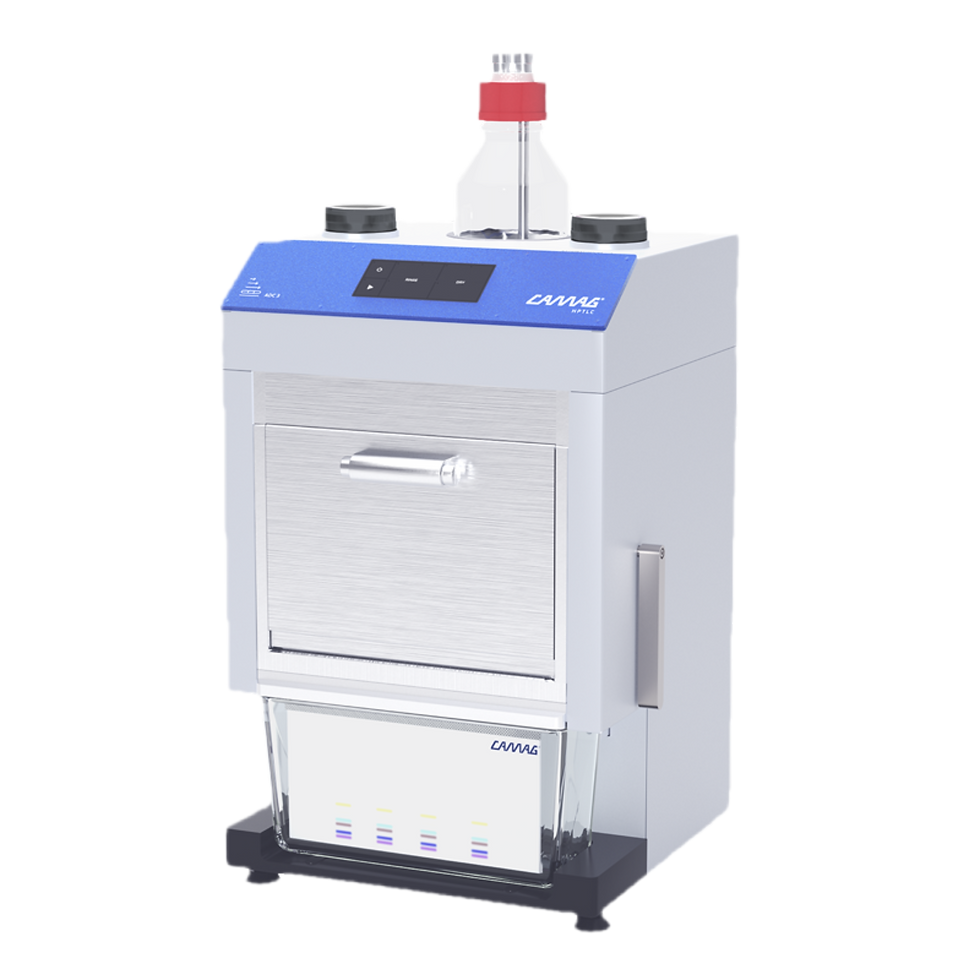
In a nutshell, the ADC3 will;
Control the timing for Chamber Saturation, Plate Activation, Pre-Conditioning, and Drying
Control when the developing solvent is introduced to the chamber
Control when the plate is introduced to the chamber
Monitor the migration distance and development time
Monitor the temperature and relative humidity
Automatically remove the plate from the solvent once the required migration distance is achieved
Dry residual solvent from the plate ready for documentation/analysis
Improve reproducibility of chromatograms!


Comments